
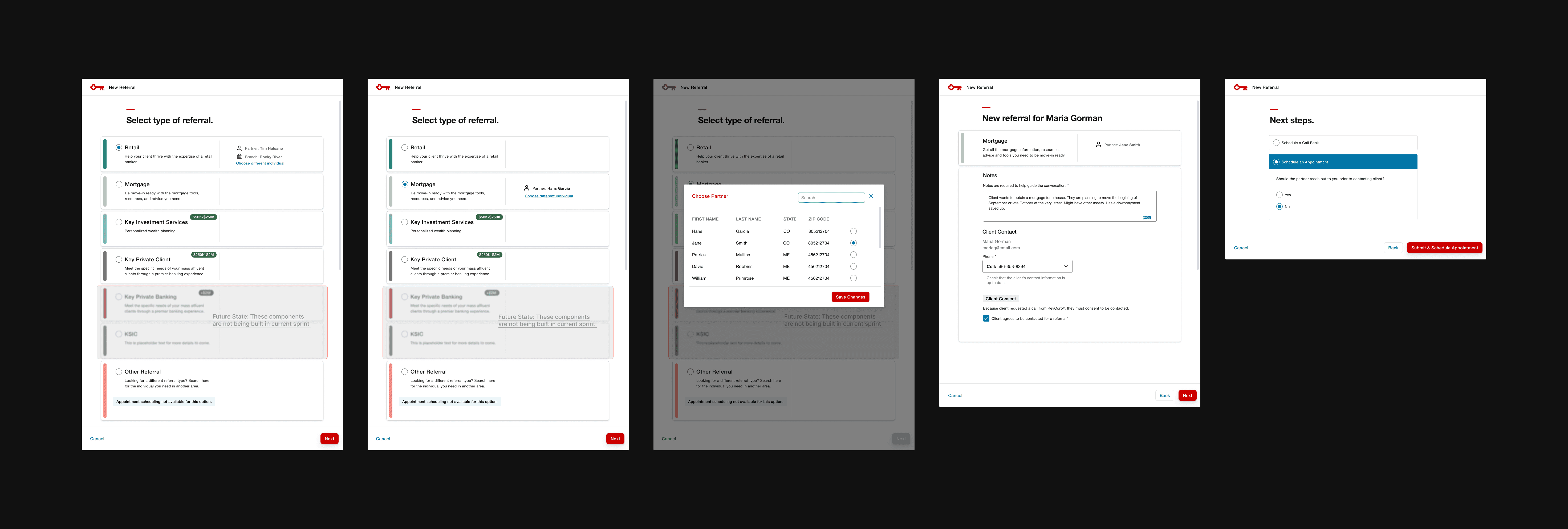
*Images are representative in nature and intentionally small due to NDA
KeyBank
Referrals Application
How I conducted user research and designed a 0-1 application that that increased referral volume by 75.4%
Project Overview
Background
Every year, bankers at KeyBank refer thousands of clients to internal partners for loans, mortgages, and credit cards. However, there was no standardized way to track or record referrals, leading to missed credits for bankers and limited visibility for branch managers.
My Role
👩🏻💻 Key Product Designer
As a Product Designer, I was tasked with researching the current referral process and creating an integrated referral-tracking tool within the bank’s internal CRM, Engage360.
Team
As a key product designer embedded in the Engage360 team, I collaborated with:
2 Product Owners
12 Software Developers
Cross-functional banking teams
Industry
Corporate Banking, Finance
Domain
Saas, Productivity, Client Relationship Management
Goal
Design a simple, seamless referral system that fits into bankers’ existing workflows — without adding friction or requiring extra tools.
Objectives | KPIs
Discovery around Referrals
Conduct user interviews to understand current referral workflows.
0-1 Application
Build a tool for sending and tracking referrals within Engage360.
System Integration
Integrate pre-existing systems to minimize development and budget costs.

“It’s difficult to remember to log my referrals because I have to then go into CE Desktop to do so. I'm jumping around to too many systems.”
Jenny M.
Personal Banker at East Greenwhich Branch
“It would be great if the partner was updated with the details as well.”
Michelle R.
Branch Manager at South Haven Branch
Research & Insights
Methodologies: User Interviews
To understand how referrals were currently handled, I conducted 9 user interviews with bankers and branch managers.
Participants were asked to walk through an early prototype and share feedback while performing referral tasks.
Questions explored:
How do you currently send referrals?
How do you decide when a client is a good fit for a referral?
What are your biggest challenges with tracking or crediting referrals?
What would you expect from a system that tracks and sends them?
Take-aways
✧ We learned what were the most frequently performed and crucial tasks that bankers performed on a daily basis and what data points they needed, and in what order to match these flows
✧ We found there was a need for a consistent place bankers could check while servicing clients that filtered and presented relevant offers to the client
✧ We discovered a need for scannable elements that could help bankers make decisions more quickly, and help them get a snapshot of the clients account and program status
Key Insights
A Need to Streamline Methodologies
Referral methods varied widely; in person, phone calls, and emails.
Tool Needs to be Centralized & Accessibility
No centralized tracking existed; records were often manual or verbal.
A Need for Quick Tracking
Bankers needed a way to record referrals quickly, ideally within seconds.
Visibility of Information
Adding notes or context to referrals was a key user need.
“If I could log it right after the conversation - without switching tools - I’d actually record every referral.”
Robin M.
07 | Section title

Michael T.
Private Client Banker - Seattle Branch

Jason C.
Personal Banker (PB) at Syracuse Branch

Robin M.
Private Client Banker (PCB) from Spokane WA Branch

Samuel N.
Personal Banker (PB) from Albany NY Branch

Laura B.
Branch Manager (BM) from Tacoma WA Branch

Emily R.
Private Client Banker - Rochester NY Branch

Jennifer S.
Personal Banker (PB) from Olympia WA Branch

Lisa T.
Branch Manager (BM) from Buffalo NY Branch

Daniela K.
Product Owner - Bellevue WA (Branch
Design Strategy & Process
The design needed to:
Fit seamlessly into the existing Engage360 dashboard, minimizing new learning.
Allow rapid entry for all referral types (in-person, phone, email).
Provide auto-filled partner data with the ability to edit if needed.
Support notes and additional context for clarity and follow-up.
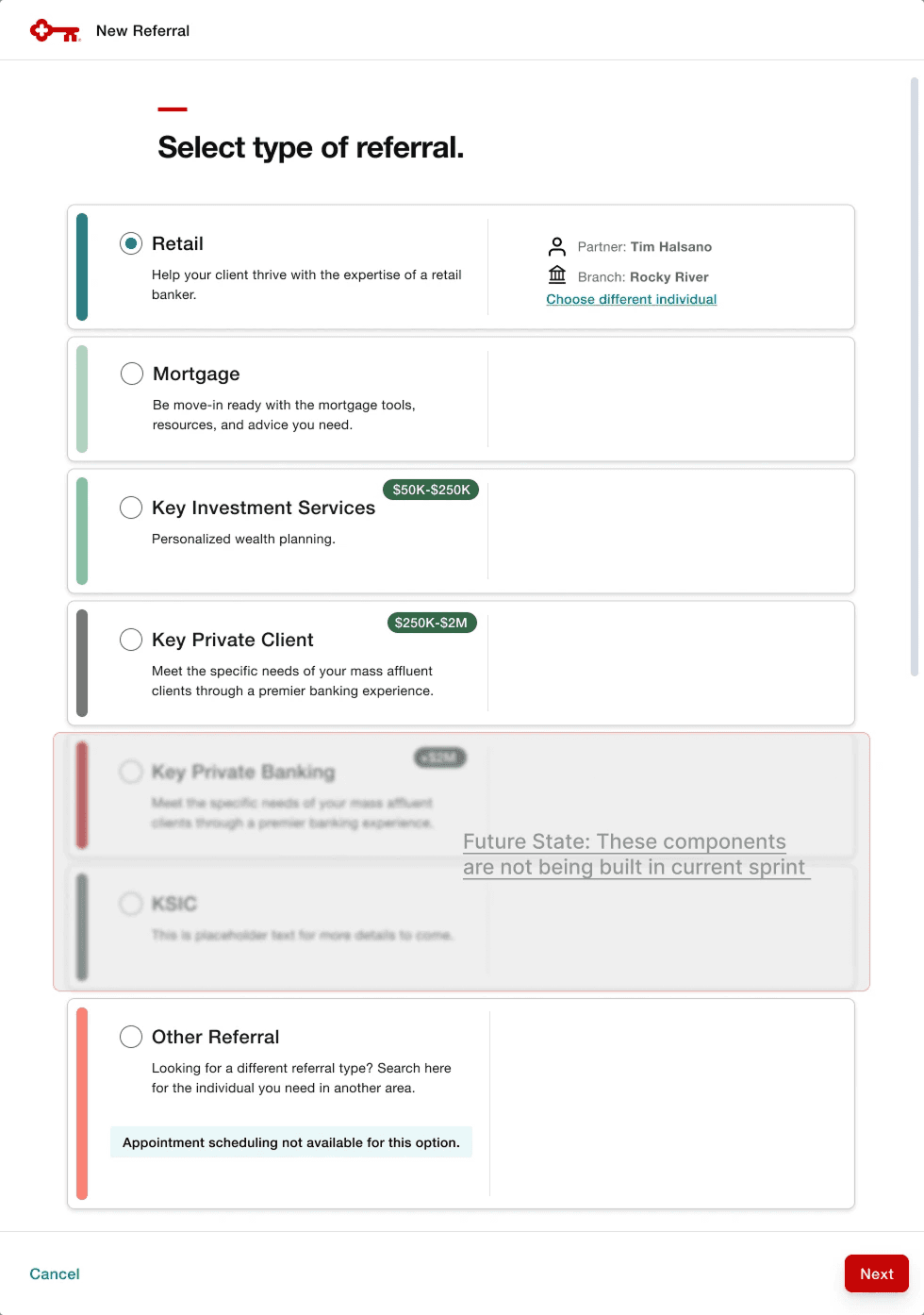
Use visual indicators to help bankers quickly assess client eligibility or tier.
Prototypes & Iteration
High-Fidelity Prototype
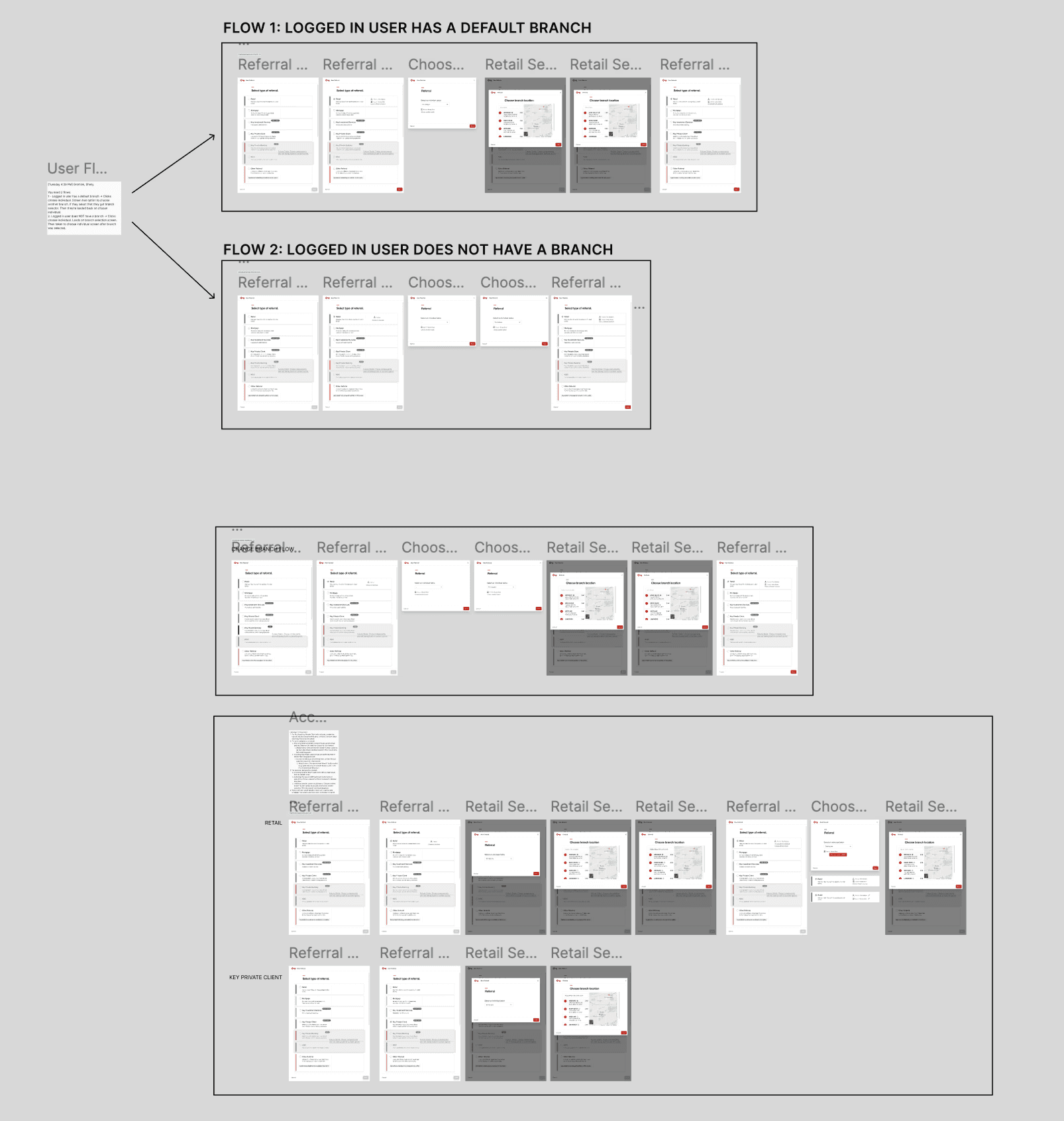
After synthesizing the research, I created a high-fidelity Figma prototype that:
Supported all main use cases for sending and tracking referrals.
Automatically populated partner and client details where possible.
Allowed free-form notes to accompany the referral.
Featured green financial tier tags to visually guide quick decision-making.
Enabled in-person referrals to be recorded in seconds — aligning with fast-paced branch environments.
Results & Impact
✓ +75.4% increase in recorded referral volume after launch.
✓ Bankers praised the tool for its simplicity and speed.
✓ Branch managers gained clear visibility into referral activity and business generation.
✓ Integrated seamlessly with existing Engage360 systems — saving on development costs.
Reflection & Learnings
This project reinforced the power of user-centered simplicity.
By deeply understanding the on-the-ground workflow of bankers, I was able to design a tool that blended into existing behavior rather than forcing new ones.
The success of this feature also highlighted how small, focused improvements in workflow design can drive major impact in large enterprise systems.
“Before this tool, I’d forget to log half my referrals because it just took too long. Now, it’s literally seconds — I finish a client call and it’s already recorded. I finally get credit for all the work I do.”
Jennifer S.
Personal Banker, West Coast Region
“The new referral tracker completely changed how we measure branch performance. We finally have visibility into where business is coming from — and it’s helped us spot cross-sell opportunities we used to miss.”
Lisa T.
Branch Manager, East Coast Region